
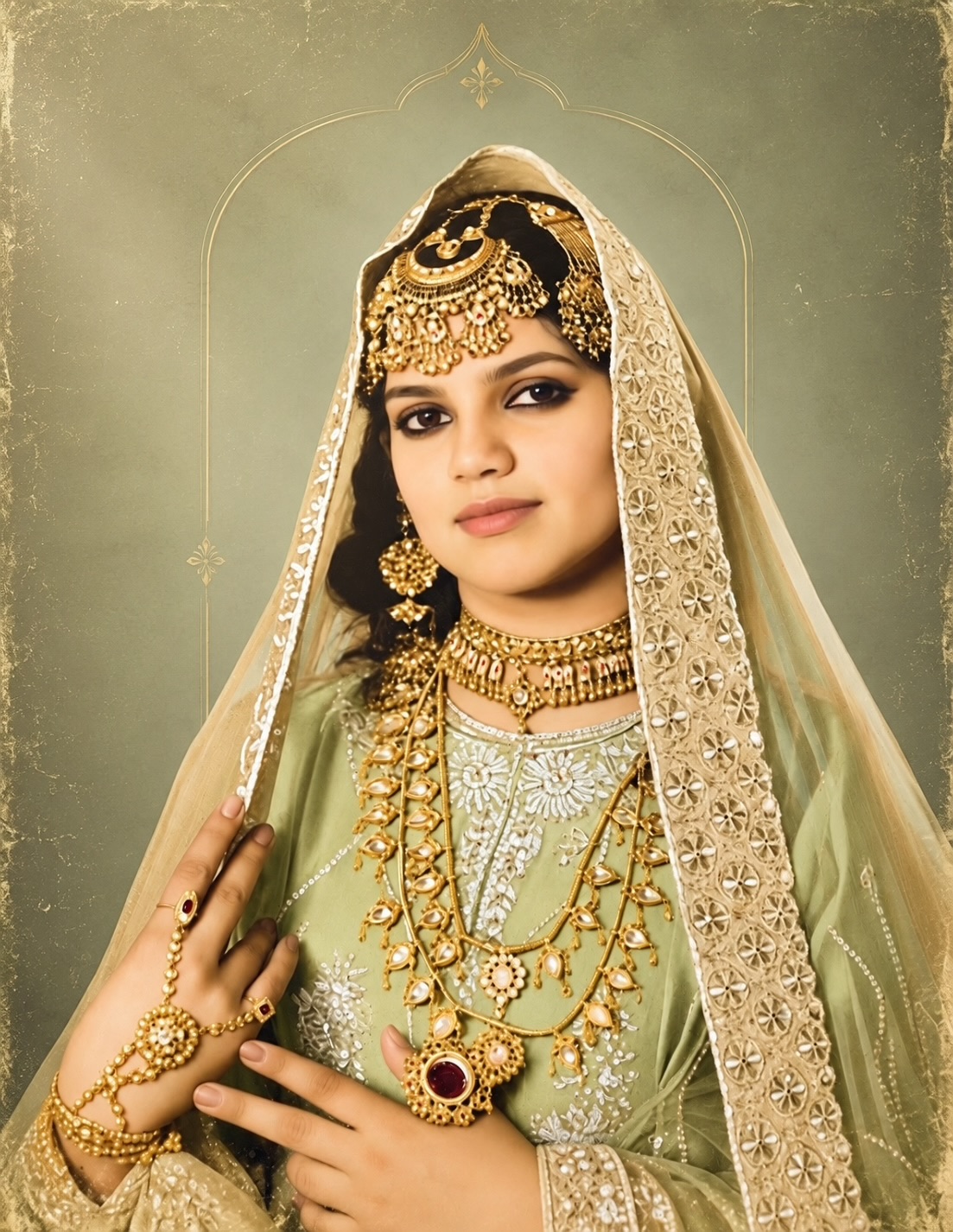
Rani Jasjeet Kaur
A Woman of Heritage, Education and Quiet Strength
Rani Jasjeet Kaur occupies a distinctive place in the history of the Guru Har Sahai Estate. Born into the distinguished Bedi family and later married into the Sodhi family of Guru Har Sahai, her life brought together two of the most historically significant hereditary Sikh lineages — the Bedis associated with the descendants of Guru Nanak Dev Ji and the Sodhis of Guru Har Sahai, descendants of Guru Ram Das Ji and custodians of the Pothimala tradition.
Remembered within the family as a woman of exceptional refinement, education and individuality, Rani Jasjeet Kaur represented a generation of women who carried tradition with dignity while embracing a distinctly modern outlook.
Early Life and Bedi Heritage
Rani Jasjeet Kaur was born around 1925 into the prominent Bedi family of Punjab. She was the daughter of Tikka Sant Singh Bedi and belonged to the family line descended from Sir Baba Khem Singh Bedi, one of the most prominent Sikh religious and public figures of nineteenth-century Punjab.
Historical references identify Tikka Sant Singh Bedi as the son of Baba Ujagar Singh Bedi of Rawalpindi. Baba Ujagar Singh, in turn, was one of the sons of Baba Khem Singh Bedi.
The reconstructed family lineage therefore places Rani Jasjeet Kaur within the following line:
Baba Khem Singh Bedi
↓
Baba Ujagar Singh Bedi
↓
Tikka Sant Singh Bedi
↓
Rani Jasjeet Kaur
This lineage connected her directly with one of the most respected Bedi houses of pre-Partition Punjab.
Education in Lahore
At a time when advanced education for women was still far from common, Rani Jasjeet Kaur pursued higher studies at Queen Mary’s College, Lahore, one of the leading institutions for women in undivided Punjab.
She studied English Honours, reflecting both the progressive outlook of her family and her own intellectual inclination.
Her Lahore education placed her among a relatively small group of highly educated women of her generation and contributed to the sophistication, confidence and independence for which she would later be remembered.
Marriage into the Guru Har Sahai Family
In 1945, at approximately twenty years of age, Rani Jasjeet Kaur married Guru Atamjit Singh Sodhi, popularly known within the family as Tikka Sahib.
Guru Atamjit Singh was the son and successor of Guru Jaswant Singh Sodhi of Guru Har Sahai and belonged to the direct hereditary line associated with the historic Guru Har Sahai Estate.
The succession of the family during this period may be traced as:
Guru Bishan Singh
↓
Guru Jaswant Singh
↓
Guru Atamjit Singh
↓
Guru Haresh Singh
Historical research identifies Guru Atamjit Singh as the fifteenth representative in the Guru Har Sahai succession from Guru Ram Das Ji.
The marriage of Rani Jasjeet Kaur and Guru Atamjit Singh therefore represented far more than a union between two prominent families. It brought together two deeply rooted Sikh hereditary traditions.
On one side stood the Bedi lineage, associated with the descendants of Guru Nanak Dev Ji.
On the other stood the Sodhi lineage of Guru Har Sahai, descending through Guru Ram Das Ji and closely associated with the custodianship of the Pothimala.
A Connection Between Two Historic Sikh Houses
The relationship between the Bedi and Guru Har Sahai families did not begin with Rani Jasjeet Kaur.
The preceding generation had already established important family ties between the two houses. Guru Jaswant Singh Sodhi, father of Guru Atamjit Singh, had also married into the family of Baba Khem Singh Bedi.
These marriages reflected the close social, religious and hereditary connections that existed among some of the most influential Sikh families of Punjab.
Through Rani Jasjeet Kaur, this connection was renewed in another generation.
Her life therefore forms an important bridge between two historic genealogical traditions.
The Guru Har Sahai Estate
Rani Jasjeet Kaur entered a family whose history was closely intertwined with the development of Guru Har Sahai.
The Guru Har Sahai Estate had grown into a substantial landed estate by the beginning of the twentieth century. Historical research records that by 1909 the family holdings comprised approximately 25,000 acres spread across nine villages, with annual estate revenues exceeding Rs 50,000.
At various times, the estate had also been administered under the British-era Court of Wards.
Beyond its landed importance, however, the significance of the Guru Har Sahai family lay in its religious and historical inheritance.
The family had long been associated with the preservation of the Pothimala, a collection of sacred manuscripts, relics and traditions that formed a central part of the spiritual identity of the Guru Har Sahai house.
By marrying Guru Atamjit Singh, Rani Jasjeet Kaur became part of this continuing historical legacy.
A Woman Ahead of Her Time
Family memories of Rani Jasjeet Kaur describe a woman who combined grace with independence of thought.
Her education, confidence and refined personality distinguished her in an era when the lives of women belonging to prominent landed families were often highly conventional.
She belonged to a generation shaped by enormous historical change — from the final decades of British India to Independence, Partition and the transformation of Punjab that followed.
Yet she carried herself with an identity that was neither confined by tradition nor disconnected from it.
She represented a particularly compelling kind of modernity: one grounded in heritage rather than opposed to it.
Her English education, sophisticated worldview and strong individuality existed alongside a deep consciousness of family, ancestry and responsibility.
Family
Rani Jasjeet Kaur and Guru Atamjit Singh had three sons.
Through them, the Bedi and Sodhi bloodlines continued into subsequent generations of the Guru Har Sahai family.
Her position within the family was therefore not merely ceremonial. She became part of the living continuity of a lineage whose history extended across centuries.
Her Place in the Story of Guru Har Sahai
The story of Guru Har Sahai has often been told through its male succession — through Gurus, estate holders, custodians and political figures.
Yet families are equally shaped by the women who enter them, preserve their memories and transmit their culture.
Rani Jasjeet Kaur belongs prominently within that story.
She arrived at Guru Har Sahai carrying with her the intellectual and genealogical inheritance of the Bedi family. Through marriage, she became part of the Sodhi house whose identity was inseparable from the history of the town and the Pothimala.
Her story therefore sits at the intersection of ancestry, education, womanhood and historical continuity.
A Legacy Beyond Titles
Within family memory she has long been known as Rani Jasjeet Kaur.
Her importance, however, extends beyond any title.
She belonged to a world of great ancestral consciousness but lived through a century in which inherited privilege alone could no longer define a person.
What remains compelling about her life is the combination of lineage and personality.
She was born into history, but she was not merely a footnote within it.
She was educated, articulate, independent and remembered.
For the descendants of Guru Har Sahai, Rani Jasjeet Kaur remains part of a larger inheritance — an inheritance not simply of estates and genealogies, but of character, memory and identity.
Genealogical Connection
Bedi Line
Baba Khem Singh Bedi
↓
Baba Ujagar Singh Bedi
↓
Tikka Sant Singh Bedi
↓
Rani Jasjeet Kaur
Marriage
Rani Jasjeet Kaur
married in 1945
Guru Atamjit Singh Sodhi
Guru Har Sahai Line
Guru Bishan Singh
↓
Guru Jaswant Singh
↓
Guru Atamjit Singh
↓
Guru Haresh Singh
Historical Note
Certain details of Rani Jasjeet Kaur’s life are presently reconstructed from family history, published biographical material, genealogical references and historical records relating to the Bedi and Guru Har Sahai families.
Research into her exact date of birth, date of death, maternal ancestry, siblings and contemporary records of her 1945 marriage remains ongoing.
As further archival material becomes available, this account may be expanded to provide an even fuller record of her life and contribution to the history of the Guru Har Sahai family.