
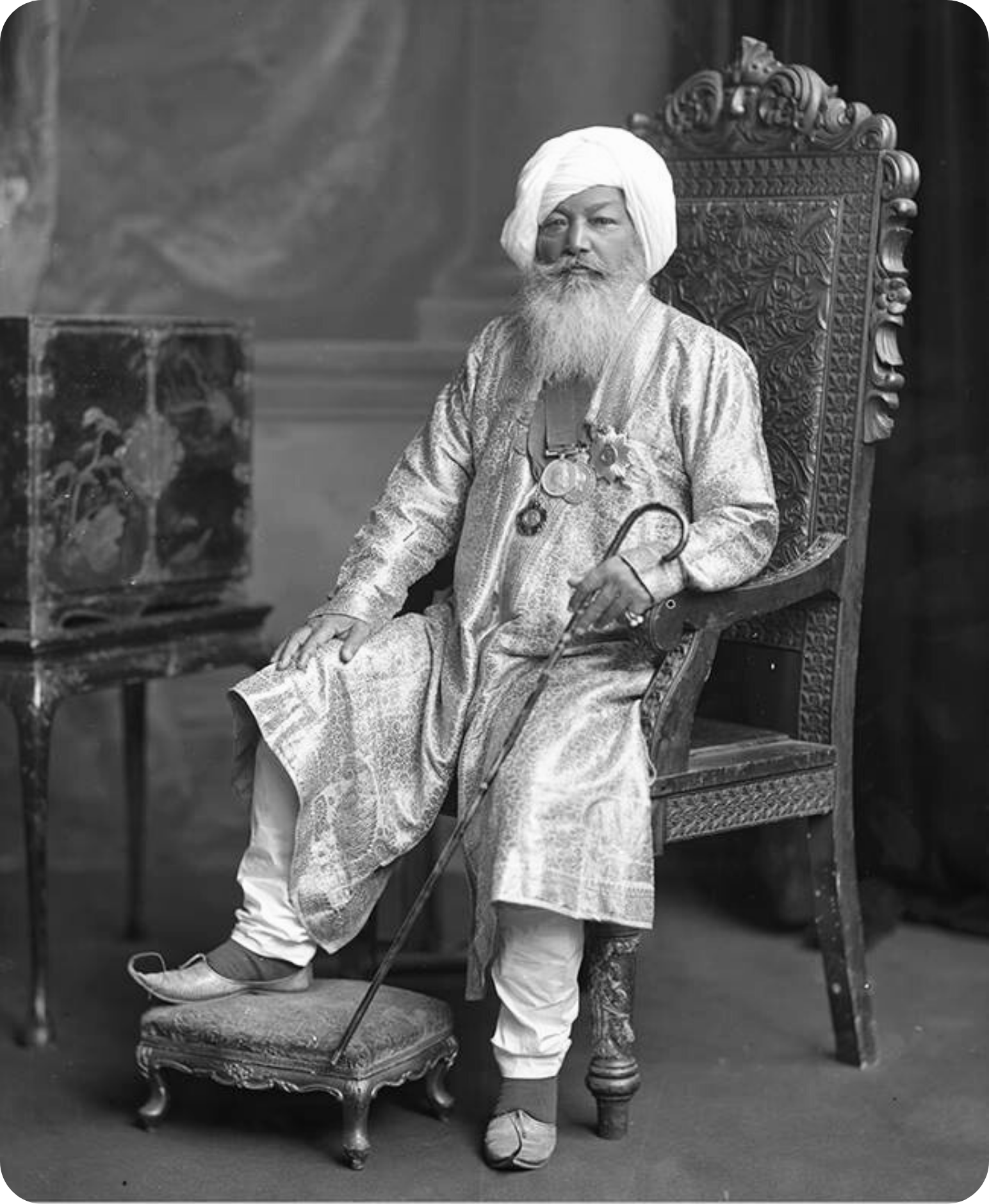
Baba Khem Singh Bedi (21 February 1832 – 10 April 1905)
Direct descendant of Guru Nanak Dev Ji • KCIE • Religious reformer • Colonial-era statesman
Baba Khem Singh Bedi was born on 21 February 1832 in Kallar and emerged as one of the most influential Sikh personalities of the 19th century. A direct descendant of Guru Nanak Dev Ji, he represented the senior-most surviving line of the Guru’s family and commanded immense spiritual, social, and political influence across Punjab during the late Sikh Empire and early British colonial period.
He was the son of Baba Attar Singh Bedi, brother of Sampuran Singh Bedi, and father of Baba Sir Gurbaksh Singh Bedi—a lineage that continued to play a significant role in the religious and political life of Punjab for generations.
Baba Khem Singh Bedi was known not only for his spiritual leadership but also for his statesmanship. His goodwill with the British administration resulted in him being honoured with the title of Knight Commander of the Indian Empire (KCIE). He maintained a strategic yet respected relationship with the colonial government, and his influence was acknowledged at the highest imperial levels.
One of the most notable recognitions of his stature was his invitation as a special dignitary to the Coronation Durbar of King Edward VII, a rare honour extended only to select royalty, princes, and leaders of exceptional standing in the subcontinent. His presence at this historic event symbolised the high regard in which he was held both by the Sikh community and by British imperial authorities.
Baba Khem Singh Bedi passed away on 10 April 1905 in Montgomery at the age of 73, leaving behind a legacy that shaped Sikh religious reform movements, political alignments, and the socio-cultural trajectory of Punjab during a period of profound transformation.
Baba Khem Singh Bedi (21 February 1832 – 10 April 1905)
Direct descendant of Guru Nanak Dev Ji • KCIE • Religious reformer • Colonial-era statesman
Baba Khem Singh Bedi was born on 21 February 1832 in Kallar and emerged as one of the most influential Sikh personalities of the 19th century. A direct descendant of Guru Nanak Dev Ji, he represented the senior-most surviving line of the Guru’s family and commanded immense spiritual, social, and political influence across Punjab during the late Sikh Empire and early British colonial period.
He was the son of Baba Attar Singh Bedi, brother of Sampuran Singh Bedi, and father of Baba Sir Gurbaksh Singh Bedi—a lineage that continued to play a significant role in the religious and political life of Punjab for generations.
Baba Khem Singh Bedi was known not only for his spiritual leadership but also for his statesmanship. His goodwill with the British administration resulted in him being honoured with the title of Knight Commander of the Indian Empire (KCIE). He maintained a strategic yet respected relationship with the colonial government, and his influence was acknowledged at the highest imperial levels.
One of the most notable recognitions of his stature was his invitation as a special dignitary to the Coronation Durbar of King Edward VII, a rare honour extended only to select royalty, princes, and leaders of exceptional standing in the subcontinent. His presence at this historic event symbolised the high regard in which he was held both by the Sikh community and by British imperial authorities.
Baba Khem Singh Bedi passed away on 10 April 1905 in Montgomery at the age of 73, leaving behind a legacy that shaped Sikh religious reform movements, political alignments, and the socio-cultural trajectory of Punjab during a period of profound transformation.
Integrated Lineage: The House of Guru Ram Das and the House of Guru Nanak
The marriage of Guru Jaswant Singh—14th direct descendant of Guru Ram Das—to Ramji (Kashmiran), daughter of Baba Khem Singh Bedi (KCIE), created one of the most historically significant alliances between two principal branches of Sikh heritage. Through this union, the lineage of Guru Ram Das converged with the pre-eminent ancestral line of Guru Nanak Dev Ji, represented in the 19th century by the towering figure of Baba Khem Singh Bedi.
This chapter integrates their legacies to illustrate the combined spiritual, political, and social influence exercised by both houses during a period of major transition in Punjab.
Baba Khem Singh Bedi (1832–1905): Custodian of Guru Nanak’s Lineage
Born on 21 February 1832 in Kallar, Baba Khem Singh Bedi was one of the most influential Sikh personalities of his era. As a direct descendant of Guru Nanak Dev Ji and son of Baba Attar Singh Bedi, he inherited a legacy of spiritual authority that carried weight across Punjab and beyond.
A reformer, statesman, and respected intermediary between Sikh communities and the British colonial administration, he was honoured with the title Knight Commander of the Indian Empire (KCIE). His stature earned him a rare invitation as a special dignitary to the Coronation Durbar of King Edward VII, positioning him among the highest-ranked leaders in India at the time.
He died on 10 April 1905 in Montgomery, leaving behind a lineage of immense stature—one that would soon intersect with the House of Guru Ram Das through his daughter Ramji.
Marriage into the House of Guru Ram Das
Ramji (Kashmiran), daughter of Baba Khem Singh Bedi, entered the household of Guru Bishen Singh, father of Guru Jaswant Singh, through a marriage rooted in both spiritual trust and political calculus.
This union brought together:
the Bedis, descendants of Guru Nanak Dev Ji, known for spiritual leadership, reform movements, and significant colonial-era influence;
the Sodhis, descendants of Guru Ram Das, custodians of the Pothi Mala tradition and holders of regional authority, land, and spiritual leadership.
The marriage strengthened both houses by uniting two of the most revered and legitimate Guru lineages in Sikh history. It elevated the standing of Pothi Mala while reinforcing the symbolic continuity between the earliest and later Gurus.
Guru Jaswant Singh (1898–1971): Leadership in a New Era
Guru Jaswant Singh, born on 16 October 1898, represented the continuation of the Guru Ram Das lineage into the 20th century. Educated at Aitchison College, he was groomed alongside princely heirs of the region, preparing him for leadership in a rapidly modernising Punjab.
His marriage to Ramji—granddaughter of the Guru Nanak lineage—positioned him uniquely at the confluence of spiritual authority, landed influence, and political capital. During his lifetime, he exercised significant regional leadership, served as an Independent MLA (1962), and maintained a revered spiritual presence among his followers.
The alliance with the Bedi family added an additional layer of legitimacy and cultural depth to his lineage, reinforcing the continuity of Sikh heritage across centuries.
A Conjoined Legacy of Two Guru Houses
The integration of these two lineages forged:
a union of spiritual authority (Guru Nanak’s house)
a legacy of institutional leadership and service (Guru Ram Das’s house)
a consolidated cultural presence across Punjab, the frontier regions, and within colonial administrative circles
This marital connection symbolised the convergence of two historic trajectories—one rooted in the origin of Sikhism, the other in the continuity of leadership within Sikh institutions. The house formed by this union stood at a rare intersection of tradition, influence, and evolving modernity.